

Startup Happy Health has found a way to make the ring we wear on our finger change color according to our mood, which can help users monitor their mental health.

Happy Ring is a ring that helps monitor your mental health – Photo: Happy Health
This ring, called Happy Ring, has just received $60 million in funding for further development. It uses transdermal electrical sensing (EDA) technology to monitor the subject's stress level in real time. Essentially, the device kicks in when the user's sympathetic nervous system kicks in.
Dr Dustin Freckleton – medical doctor and CEO of Happy Health – describes: “When we start to have difficult thoughts or experience strong emotional episodes, our brain responds to help. we respond to those stimuli. The EDA sensor helps measure those changes through the fingers.”
Mr. Freckleton went on to explain that the Happy Ring's EDA sensor looks for sweat glands on the skin of your hand, then feeds it into an algorithm that determines your emotional state. Based on what is obtained, the ring will adapt the artificial intelligence model to the individual's data, rather than comparing the person's data with a predefined group of users.
Sean Rad, founder of Happy Health and Tinder, said: “Our device will continuously update information related to your mood so you understand when you are calm, alert or stressed. . At the same time, that data will be used to personalize exercises to help manage stress and improve mood and overall health for users."
Mr. Rad also added that, from a security and standards perspective, the device won't go into too much detail than what Happy Health's privacy policy covers.
Those exercises include activities like breathing, meditation, and keeping a mood diary. All exercises can be completed within the app and simultaneously tracked by the ring itself upon completion.
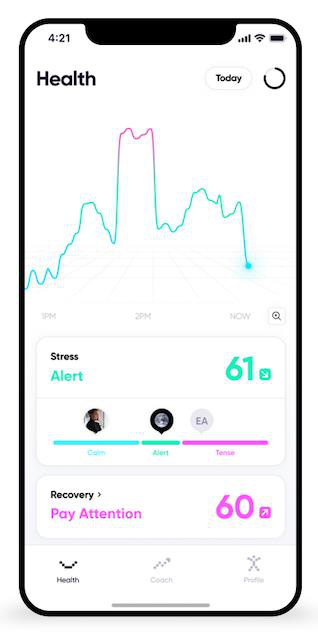
The application connects to the device to display emotional parameters to the user – Photo: Happy Health
Other wearables like the Fitbit Sense, Sense 2 and even Manchester City's upcoming smart scarf also feature EDA sensors as a means of tracking stress episodes.
According to Dr. Freckleton, integrating those functions into a ring would be more suitable than wrist or torso-based monitors for measuring stress levels. For example, Fitbit Sense requires users to put their hands on the screen to be able to give accurate data.
The device's sensors also include four skin electrodes, four wavelengths of light, an accelerometer, and two temperature sensors. It also tracks sleep and overall activity and has an estimated battery life of up to three days.
At first glance, these features seem to be available in Oura Ring or Whoop 4.0 – minus the custom EDA sensor. However, the Happy Health founder said the Happy Ring is more focused on the user's mental state, while other wearables on the market only track heart rate variability as a proxy for fitness levels. recovery of the body after stress.
From the Internet
 English
  Vietnamese