

Recently, many hospitals have developed technology applications, putting artificial intelligence (AI) into application in treatment. Patients can save time to receive results, faster, more compact and more effective.
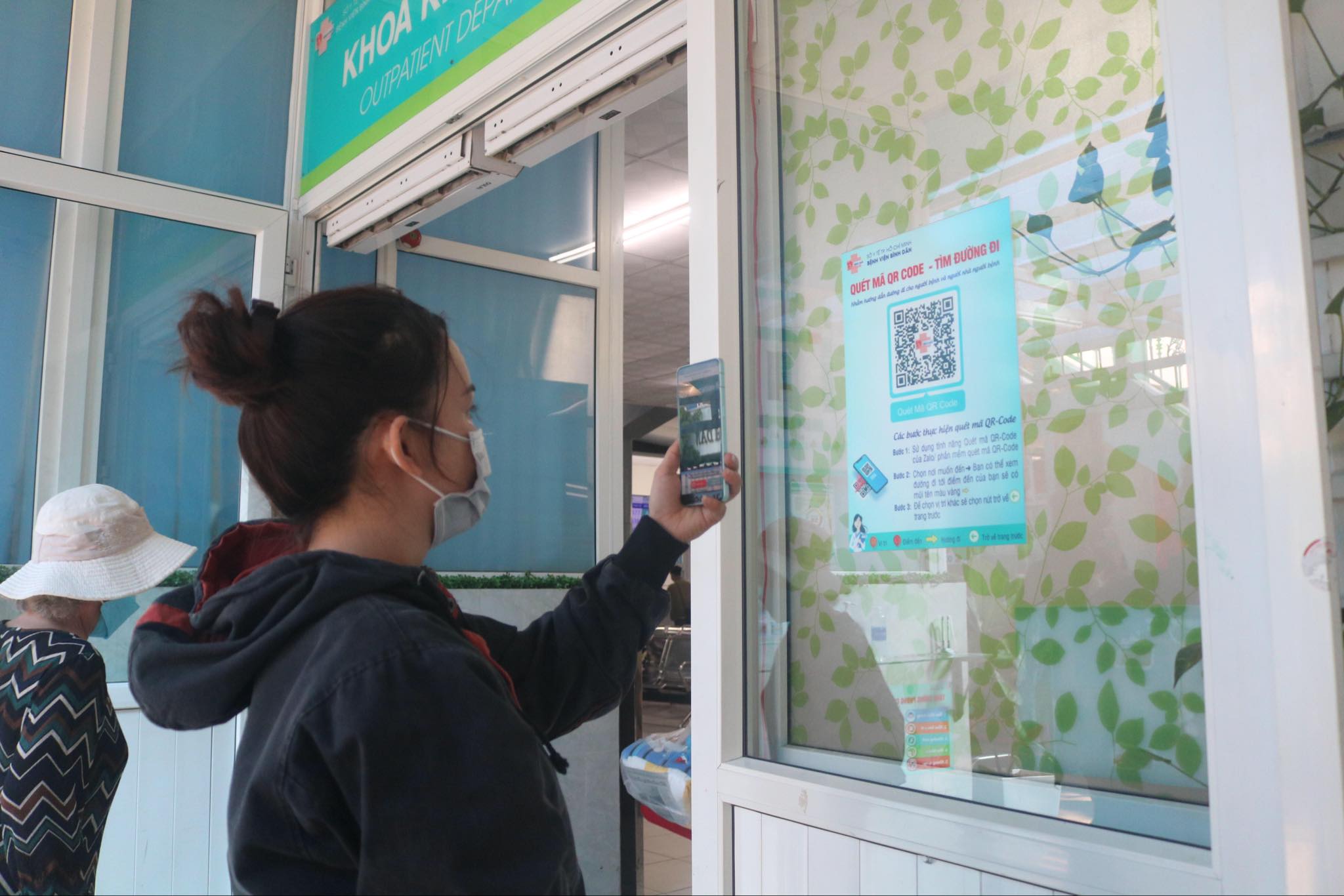
A patient is scanning a QR code to use a navigation technology application in the hospital at Binh Dan Hospital (HCMC) – Photo: THU HIEN
How do patients use information technology and AI when going to the doctor?
Fast, compact, efficient
At more than 6 am, Ms. NTB (46 years old, Binh Duong) prepared to go to the hospital for medical examination. Unlike the previous times, she had to wait for the blood test results at 10am, but now at 9:30am, she has received an SMS from the hospital (via phone) with the test results. She saved more than half an hour of waiting time.
This is the first time Ms. B has been notified by the hospital of receiving test results via text message, one of the applications that have been deployed in a number of hospitals in Ho Chi Minh City.
Ms. B. said that if she went to the doctor before, it took a long time to return the test results, so she had to wait, watch the doctor read the name, wait in line to get it. Now, with the method of sending messages, she can save time to go home early to rest.
“Getting the results early, I save a lot of time, I can go home earlier to rest and work less hard,” said Mrs. B.
Similarly, at 5 am, Ms. LH (37 years old, living in Hoc Mon) woke up early to go to Binh Dan Hospital (HCMC) for a gastric examination. The most obsession every time Ms. H. goes to the hospital is to find the way, every time she wants to find the way, she has to ask many people to get to the areas of the hospital.
“Many hospitals have complex building designs, every morning the visits are crowded, I see many instructors having to talk constantly. Many people ask, so I have to wait for them to finish asking, then continue to ask after a while”, said Ms. H.
But now, with a smartphone in hand, she only needs to scan the QR code at the entrance, she can see all areas of the hospital, where she is standing, just go to the area. endoscopy, testing, canteen… the app shows the way.
“Very convenient and saves time and effort. When my family members in the province come to visit, they are also less surprised. Hopefully the hospital will have many applications to support patients like this,” said Ms. H.
Many hospitals in Ho Chi Minh City have applied a series of technologies to reduce patient waiting procedures such as: Cho Ray Hospital (HCMC) with X-ray application with results within 20 seconds. After taking the picture, quickly show the image of the original lesion area (if any), helping the radiologist to read the film faster, without missing the lesion. Nguyen Tri Phuong Hospital uses AI to control anesthesia…
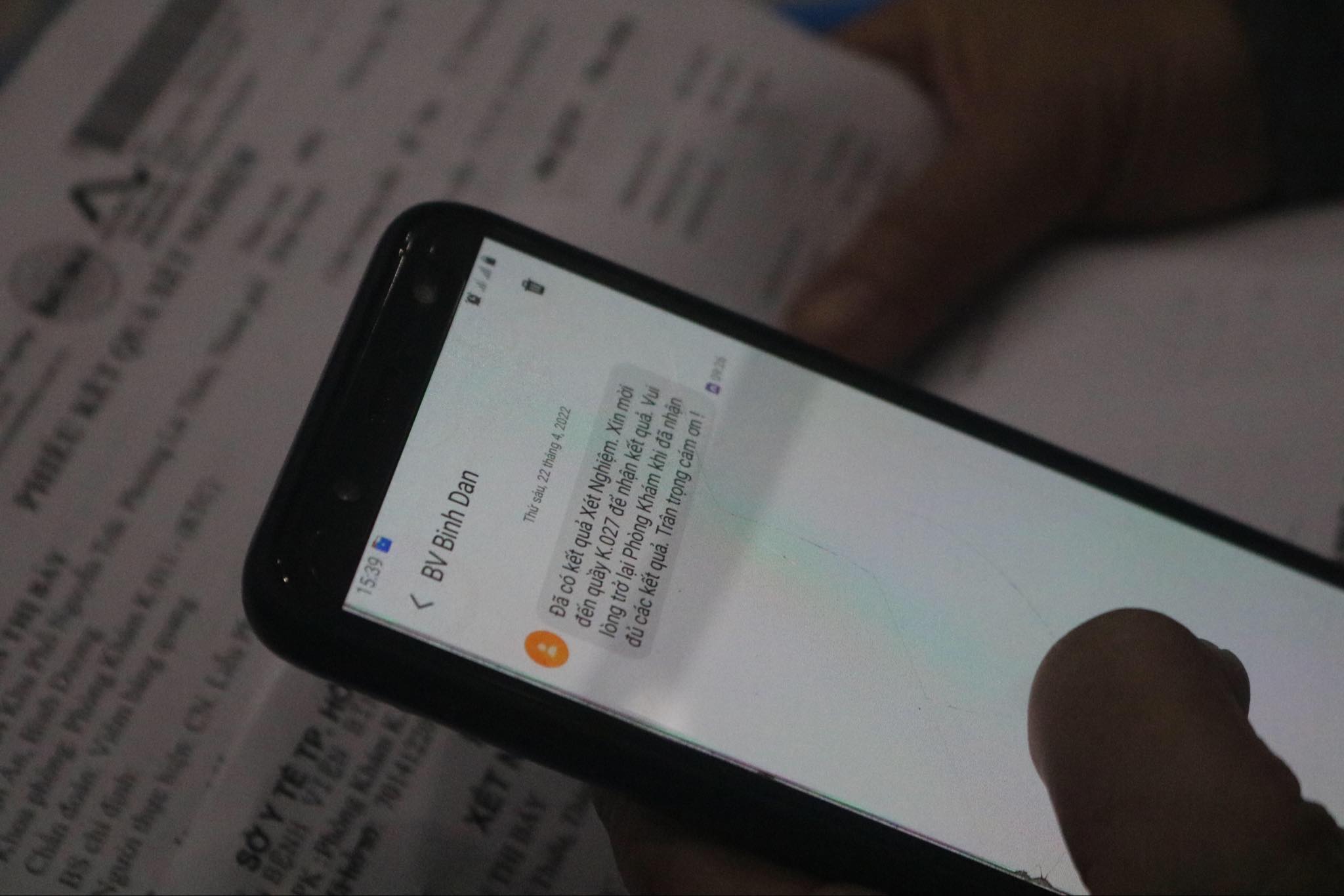
Patients are notified by text message to get the results immediately after the test results are available thanks to a modern information technology system – Photo: THU THIEN
Double profit
MSc Nguyen Ho Vinh Phuoc - head of the social work department, Binh Dan Hospital in Ho Chi Minh City - said that stemming from the fact that the number of patients visiting each day is crowded, about 2,000 visits per day, the areas of the hospital. The hospital layout is very large, distributed in many places, so it is very difficult for patients to find their way. In addition, due to the impact of the COVID-19 epidemic, face-to-face communication poses a potential risk of infection. Therefore, the hospital has developed a map application for patients, simply scanning a QR code to display every location of the hospital, minimizing the risk of infection.
“Developing these applications is not difficult, investment costs are not high, convenient for patients, we have installed a free WiFi system. As for the return of test results via SMS, it is possible to avoid congestion, patients are more flexible, in time they can take advantage of rest, "said Dr. Phuoc.
According to Dr. Phuoc, in the future, the hospital is developing technology to help patients not need to go to get test results but transfer these results directly to the clinic, the hospital is still implementing outpatient electronic medical records. Currently, all patients admitted to the doctor are making electronic medical records, the doctor can view the results on the computer…
“All software is written by the hospital's information technology team, completely managed by the hospital, with a firewall system installed to prevent intrusion, so the patient's information security problem The patient is completely guaranteed,” said Doctor Phuoc.
Cho Ray Hospital has started to deploy a complete medical information technology solution including a set of AI artificial intelligence solutions, a digital X-ray system...
Dr. Lam Viet Trung - deputy director in charge of expertise of Cho Ray Hospital in Ho Chi Minh City - said that every day the hospital receives more than 10,000 visits of patients for examination and treatment. Therefore, the application of AI, science and technology 4.0 to serve patients is very necessary.
The Department of Health of Ho Chi Minh City encourages hospitals to visit, learn, and share experiences with each other in implementing information technology applications. Especially the application of information technology in surveying patient satisfaction and patient's experience when coming to medical examination and treatment. There are solutions to prevent data loss and hospital information, organize rehearsals in case of data loss due to many causes such as natural disasters, fires, etc.
From the Internet
 English
  Vietnamese